UK warns Russian energy attacks threaten civilians and nuclear safety in Ukraine
Ambassador Neil Holland warned the OSCE that attacks on Ukraine’s energy network put civilians and nuclear safety at risk. An outage he cited at Zaporizhzhia occurred on 8 November and was resolved the same day.
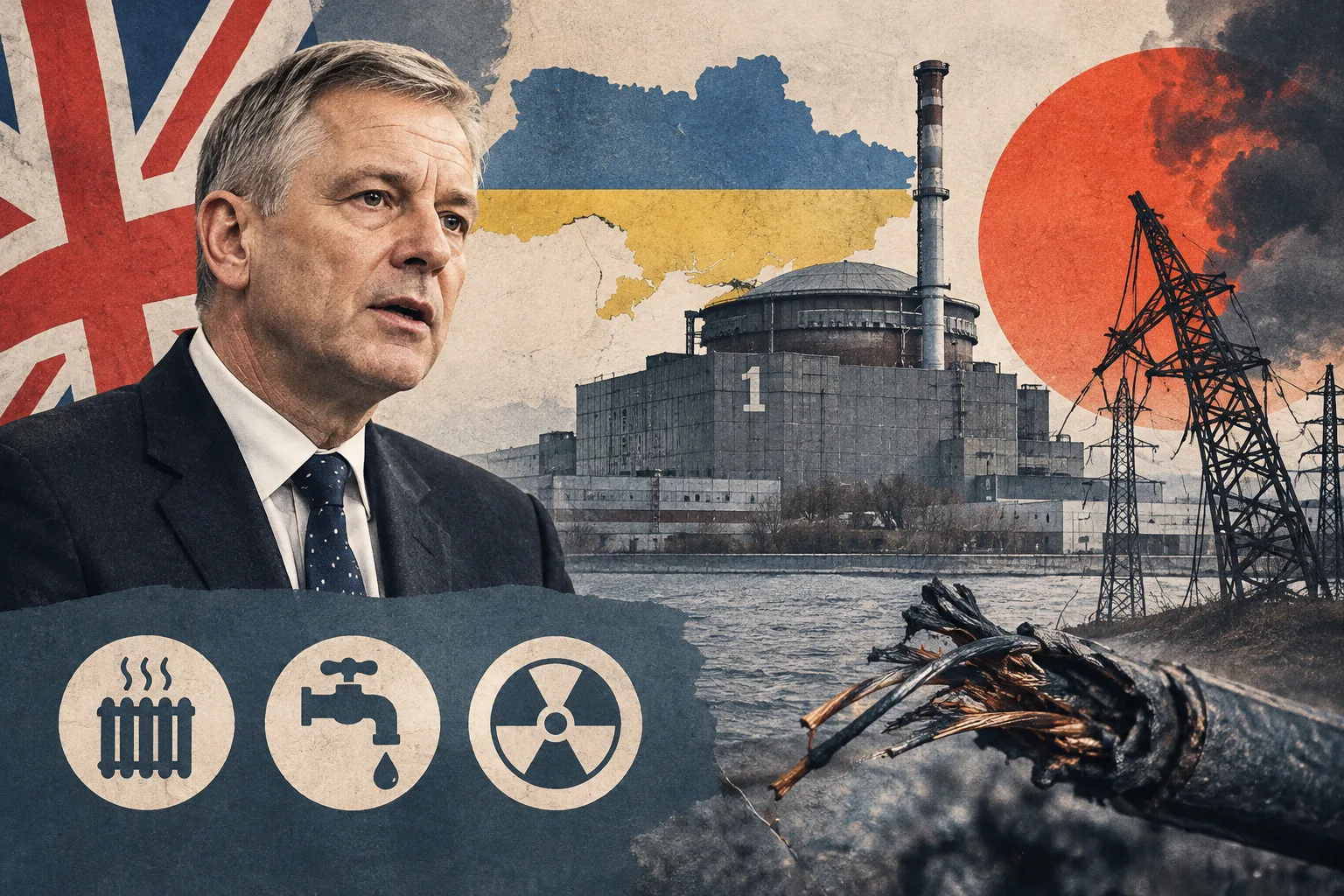
Russian attacks on Ukraine’s energy infrastructure threaten heating, water and nuclear safety as winter approaches, Britain’s ambassador to the OSCE, Neil Holland, told the organisation on 19 November. He called for Russia to stop attacks on civilians and civilian objects and agree to a comprehensive ceasefire.
Ukraine’s prime minister, Serhii Koretskyi, said on 16 November that Russian strikes on power lines and substations in the Zaporizhzhia and Dnipropetrovsk regions had left hundreds of thousands of people without electricity.
One example Holland cited was the loss of all external power at the Russian-occupied Zaporizhzhia nuclear plant. The outage occurred on 8 November, when its only remaining external power line was disconnected. It was restored the same day, after 15 hours and five minutes, according to Ukraine’s nuclear operator Energoatom and the OECD’s Nuclear Energy Agency.
The International Atomic Energy Agency (IAEA) said damage to the Ferosplavna-1 line caused the outage, the plant’s 27th complete loss of external power since the conflict began. In its 14 November update, the agency did not say what caused the damage.
Four emergency diesel generators started automatically to power essential safety systems before the plant switched to two to conserve fuel, the IAEA said. All six reactors are shut down, but electricity is still needed to cool nuclear fuel and operate safety systems.
The agency also said a backup transformer near the plant, previously repaired under an IAEA-brokered local ceasefire, had again been destroyed by military activity. The IAEA also said grid fluctuations had activated emergency diesel generators at several facilities in the Chornobyl exclusion zone during the week before its 14 November update.
Three European and Nordic nuclear safety groups warned on 16 November that further damage could lead to a nationwide grid failure, with serious consequences for nuclear safety. Alexander Nikitin, a nuclear expert at the environmental organisation Bellona, said an outage at a plant whose reactors had long been shut down and cooled would be less dangerous than an equivalent interruption at an operating plant.
An independent UN commission concluded in October that Russian authorities had committed war crimes and crimes against humanity through attacks on Ukraine’s energy infrastructure. Its investigation focused particularly on the winter of 2025–26 and the cumulative effects since autumn 2022.
The commission also examined Ukrainian attacks on energy infrastructure in Russia and occupied Ukraine, but said it could not investigate their effects further because Russia did not grant access or respond to its requests. A separate UN human rights monitoring mission reported that Ukrainian forces had also attacked electricity and heating infrastructure in Russia’s Belgorod region during the same winter, with reported power and heating outages.
Sign in to give this article a thumbs up or down.
From the discussion
Private test discussion. Comments are readers’ views and are not yet automatically fact-checked. Editing is available for 60 seconds after posting.
Sign in with a confirmed reader account and choose a username to read comments and participate.
Sorting applies to top-level comments; replies remain oldest first. New comments and likes can change the order. Refresh for the current ranking.
Loading comments…