US environmental lawsuits fell sharply under Trump as coal inquiry faces scrutiny
A review found far fewer new EPA-referred civil lawsuits in the first year of Donald Trump’s second term. New reporting also raises questions about a disputed coal-company investigation.
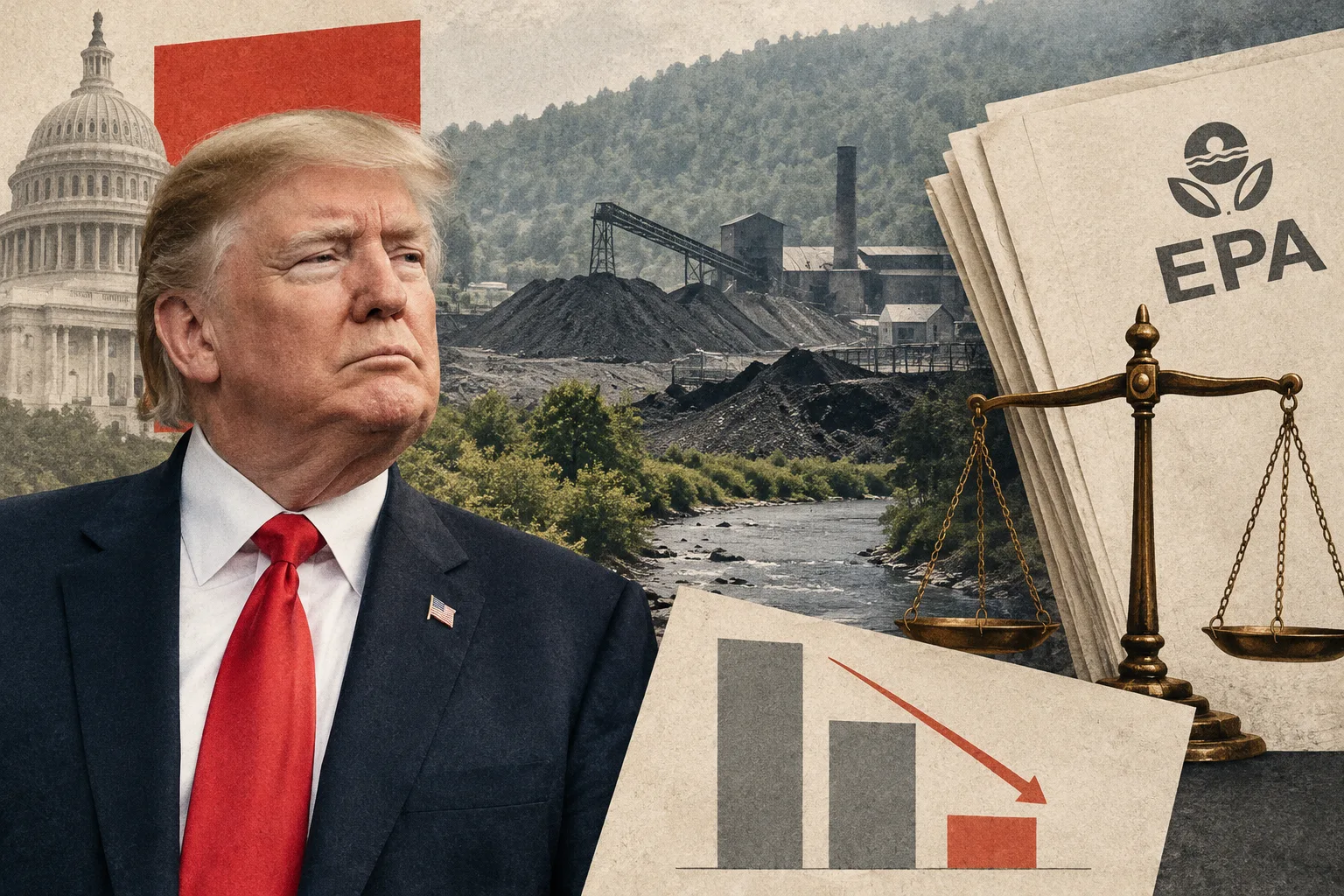
The US Justice Department filed far fewer new civil environmental lawsuits referred by the Environmental Protection Agency in the first year of Donald Trump’s second term than under his predecessors, according to a review of court records.
The Environmental Integrity Project, an advocacy group, counted 16 such civil complaints in the first year of Trump’s second term, compared with 67 in Joe Biden’s first year and 86 in Trump’s first term. The figures concern new court cases, not all federal environmental enforcement.
The decline in new court cases does not mean every form of enforcement fell. The same group found that administrative cases settled from inauguration to 30 September 2025 were up 35% on the equivalent period under Biden. Such cases are handled by the EPA rather than brought to court.
The EPA reported concluding 2,127 civil judicial and administrative cases in the 2025 financial year, including 49 judicial cases. That year began in October 2024, before Trump took office, and concluded cases are a different measure from new lawsuits. The Environmental Integrity Project also noted that cases can span administrations.
A disputed coal investigation
MS NOW has reported new details about a criminal investigation into Southern Coal and affiliated companies owned by Republican Senator Jim Justice of West Virginia.
MS NOW said two people familiar with the matter told it that prosecutors opened a criminal investigation in February 2025 after former employees claimed the companies had falsified water-pollution test results. According to those sources, prosecutors were ordered in February 2026 to withdraw subpoenas and close the investigation.
MS NOW reported that the alleged order followed an objection from a company lawyer to the office of then-deputy attorney general Todd Blanche. ProPublica and Mountain State Spotlight had reported the investigation’s closure in June. The contact alone does not establish improper political influence.
The Justice Department told MS NOW it “did not shutter any investigation”. Steven Ruby, a lawyer for the Justice family businesses, said the companies had given the department evidence refuting the allegations and it had found no basis to continue. Senator Justice denied that water tests had been falsified.
Residents interviewed by MS NOW in Wyoming County said they could not safely drink or bathe in their tap water, and some blamed local mining. A 2025 poster by a state-led investigation team described a separate water inquiry in the county: roughly ten homes were retested because of elevated manganese, and the final results were within drinking water standards. That inquiry did not necessarily cover the homes in MS NOW’s report.
Cases in Louisiana and Mississippi
In March 2025, the Justice Department dismissed a civil suit against Denka over emissions from its neoprene plant in LaPlace, Louisiana. It linked the decision to Trump’s policy against diversity programmes and said the Biden administration had improperly used an environmental justice approach.
The 2023 complaint said Denka’s monitoring stations recorded average chloroprene concentrations of 0.41 to 2.89 micrograms per cubic metre between April 2018 and January 2023. The EPA estimated that exposure to 0.2 micrograms per cubic metre over 70 years corresponded to an additional cancer risk of one in 10,000. The department said the complaint had not alleged a breach of a regulatory air-quality standard.
In Mississippi, the Justice Department attempted to end a citizen lawsuit brought by the NAACP against Elon Musk’s company xAI over gas turbines supplying a data centre. The government argued, among other things, that the suit could affect national security. On 19 October, a federal judge allowed the government to intervene but rejected its claim that it could unilaterally dismiss the suit.
On 30 October, the judge also rejected xAI’s own request to dismiss the case, ruling that the turbines were not exempt as mobile sources. Mississippi’s environmental authority had previously told the company that the proposed turbines were exempt, provided they remained portable and temporary. The rulings did not finally decide the alleged violations.
In a recent preprint, researchers from MIT and Carbon Mapper estimated average nitrogen oxide emissions from the plant after February 2026 at 870, plus or minus 165, kilograms an hour. They calculated that this was about 19 times the expected emissions from a permitted configuration of 41 permanent turbines with pollution controls. The comparison is not, by itself, a finding that the plant exceeded a particular legal limit.
MS NOW also cited figures suggesting civil environmental penalties fell to less than 1% of the previous year. But the Earthjustice analysis it cited compared $1.88 billion collected in 2024 with $15.1 million imposed under Trump by December 2025. Those are different measures and do not compare two complete calendar years.
Sign in to give this article a thumbs up or down.
From the discussion
Private test discussion. Comments are readers’ views and are not yet automatically fact-checked. Editing is available for 60 seconds after posting.
Sign in with a confirmed reader account and choose a username to read comments and participate.
Sorting applies to top-level comments; replies remain oldest first. New comments and likes can change the order. Refresh for the current ranking.
Loading comments…