US gasoline prices fell. Was it a one-day record?
US gasoline got cheaper before and after the midterm elections. Benny Johnson calls the drop a one-day record. The national weekly figures confirm the decline, but cannot establish that record.

The US gasoline price fell sharply around the 3 November midterm elections. The federal Energy Information Administration (EIA) recorded a national average for regular gasoline of $4.153 per gallon on 2 November, $3.995 on 9 November and $3.805 on 16 November. That is a fall of 34.8 cents per gallon, or about 8.4 per cent, over two weeks. A 50-litre fill-up would cost about $4.60 less at those national averages. [3]
What does Benny Johnson claim?
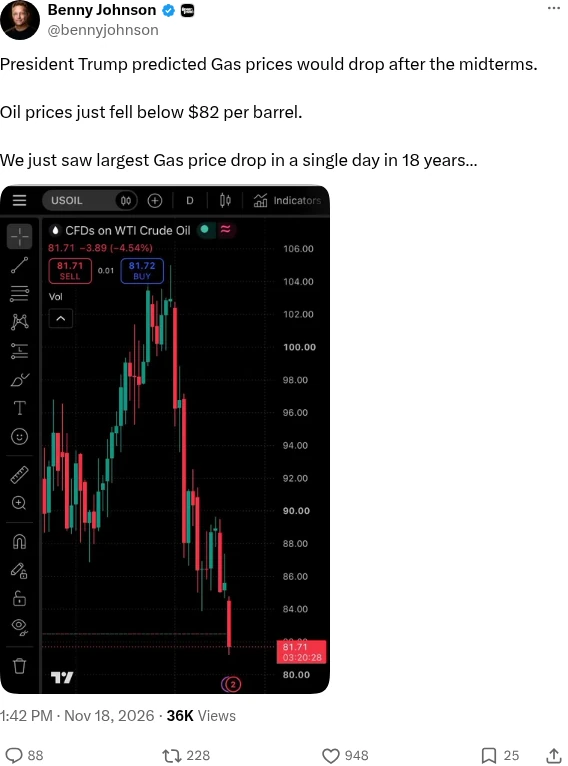
US commentator Benny Johnson wrote on X on 18 November that Donald Trump had predicted prices would fall after the midterms. Johnson added that gasoline prices had just posted their biggest one-day drop in 18 years. The chart in his post shows a contract on US WTI crude oil. Johnson gives neither a measurement date nor a daily series of retail gasoline prices against which to check the record. [1]
What period is Patrick De Haan comparing?
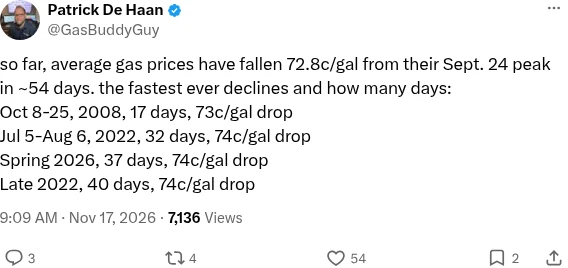
Patrick De Haan, head of petroleum analysis at GasBuddy, wrote on 17 November that the average gasoline price had fallen 72.8 cents per gallon from its 24 September peak over roughly 54 days. He cited earlier periods when prices fell by about the same amount in less time, including the summer of 2022. His comparison measures the speed of a roughly 73-cent decline over several weeks. [2]
What do the price series show?
The EIA recorded a fall of 19 cents per gallon from 9 to 16 November. GasBuddy’s 16 November report showed a drop of 21.3 cents in a week to a national average of $3.74 per gallon. The figures come from separate series, and both show cheaper gasoline that week. Verifying a one-day record would require national daily figures measured consistently across the full comparison period. [3] [5]
Prices were already falling before the election. In the EIA series, the national average went from $4.478 per gallon on 21 September to $4.269 on 26 October and $4.153 on 2 November, the day before voting. The EIA lists crude oil, refining, distribution and taxes as components of the pump price. Seasonal demand and gasoline formulations can also affect it. The price series cannot show how much of this fall each factor caused. [4] [6]
How do the Iran war and attacks on Russian refineries matter?
In March the IEA described the Iran war as the largest supply disruption in the history of the global oil market. Before the war about 20 million barrels of crude oil and oil products passed through the Strait of Hormuz every day. That flow almost stopped. Gulf producers cut output by at least 10 million barrels a day, according to the IEA. Brent was around $92 a barrel when the report was written, about $20 above its level when the war began. The Gulf disruption is a major documented cause of that rise. [9]
The Iran war had disrupted oil supplies from the Persian Gulf. The International Energy Agency (IEA) says Gulf crude exports recovered in October to around 82 per cent of their pre-war level. Global oil supply exceeded demand that month for the first time since the war began. That recovery can put downward pressure on crude prices. Crude oil is one element of US pump prices. [6] [7]
Ukrainian attacks on Russian refineries mainly affect the processing of crude oil into fuels. Reuters reported on 18 November that two industry sources estimated daily processing was about 45 per cent below late October. The November average to date was 5 to 10 per cent below September and October levels, according to the same sources. The IEA says ongoing attacks continue to restrict Russian diesel supplies to international markets. [7] [8]
Direct exposure to Russian oil has fallen. Eurostat puts Russia’s share of EU petroleum oil imports in the second quarter of 2026 at 1.0 per cent. That figure measures the EU’s direct imports. Less Russian diesel on the global market can also affect buyers who source their fuel elsewhere, because they compete with other countries for the same supply. [6] [7] [10]
US gasoline can get cheaper while global diesel supply stays tight. The sources show effects on refining and diesel supply. They do not estimate a separate effect of the Ukrainian attacks on US gasoline prices. [3] [6] [7] [8]
Conclusion
The price decline was real and had already begun before election day. The weekly figures do not establish Johnson’s one-day record. De Haan’s comparison shows how the result changes when measured from an earlier peak. The figures give no indication that the decline was delayed until after the vote. [1] [2] [3] [4]
Sign in to give this article a thumbs up or down.
From the discussion
Private test discussion. Comments are readers’ views and are not yet automatically fact-checked. Editing is available for 60 seconds after posting.
Sign in with a confirmed reader account and choose a username to read comments and participate.
Sorting applies to top-level comments; replies remain oldest first. New comments and likes can change the order. Refresh for the current ranking.
Loading comments…