News Made Clear · Loading…
Category
Regions
Continents
Lagarde warns energy shock will keep euro area inflation above target into 2027
Loading statistics…
ECB President Christine Lagarde says euro area inflation is expected to remain above target into the first half of 2027, as the bank weighs the energy shock against a resilient economy.
Review information is loading.
Christine Lagarde says the European Central Bank faces a difficult balance as energy prices rise: inflation is expected to stay above target into the first half of 2027, but the euro area economy has so far proved resilient despite the Middle East conflict and wider trade tensions.
In a statement to the International Monetary and Financial Committee on 17 October, the ECB president said the bank’s Governing Council had raised interest rates by 0.25 percentage points in September, following an equal increase in June. She said the energy shock was too large to ignore, but that a measured response remained appropriate.
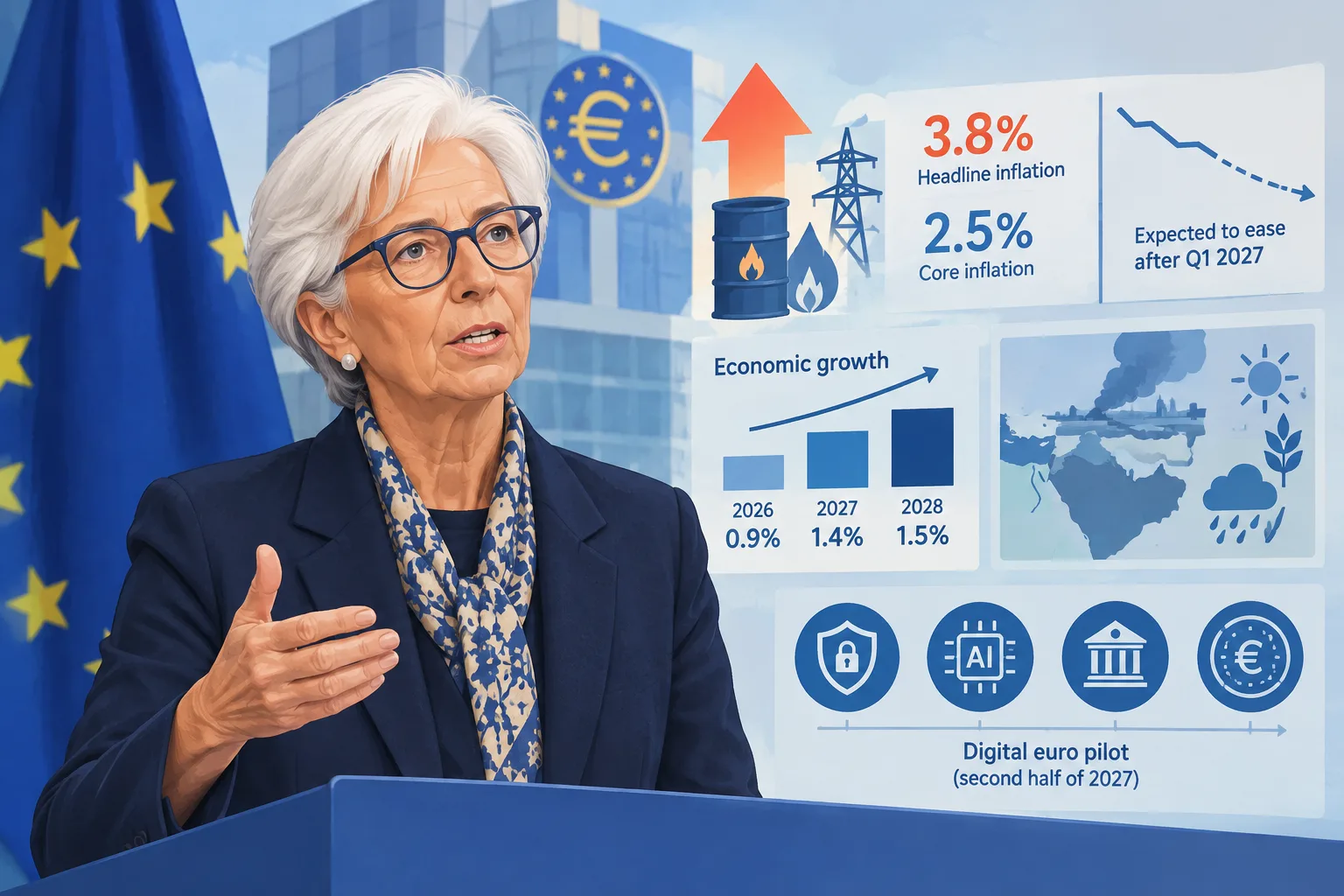
Euro area headline inflation reached 3.8% in September, Lagarde said, driven mainly by energy prices. Core inflation, which excludes energy and food, rose slightly to 2.5%. The ECB expects inflation to ease after the first quarter of 2027 and return to around its target towards the end of that year.
The bank’s September projections forecast euro area growth of 0.9% in 2026, rising to 1.4% in 2027 and 1.5% in 2028. Lagarde said growth had been broad-based across most countries and sectors in the first half of 2026. She cited investment in artificial intelligence and digital technologies, as well as public spending on infrastructure and defence, as potential supports.
But she warned that risks to growth were tilted downwards and those to inflation upwards. A more intense or prolonged energy shock could feed through into other prices and wages, while extreme weather could raise food prices. The Middle East conflict and Russia’s war against Ukraine were among the risks to the inflation outlook, she said.
Lagarde also said the ECB had so far seen no significant pass-through from higher energy prices to other prices and wages beyond what was already included in its projections. At the same time, financing conditions had tightened, with long-term interest rates rising since the bank’s previous meeting; she said this could slow growth and limit the spillover into inflation.
The statement also highlighted financial-stability concerns, including cyber and operational risks linked to artificial intelligence and the concentration of critical technology providers. Lagarde said euro area banks had strong capital and liquidity buffers, while warning that stress in private credit markets and vulnerabilities among non-bank financial firms could amplify market pressures.
On payments, she said the Eurosystem planned to run a 12-month internal pilot of the digital euro in the second half of 2027. The ECB says adoption of the legislation establishing the digital euro by the end of 2026 is key to keeping that timetable possible. [1]
How do we know?
1 listed sources · explore evidence, limitations and provenance.
Sign in to give this article a thumbs up or down.
About this discussion and AI questions
Private test discussion. Comments are readers’ views and are not yet automatically fact-checked. Editing is available for 60 seconds after posting.
Sign in with a confirmed reader account and choose a username to read comments and participate.
Sorting applies to top-level comments; replies remain oldest first. New comments and likes can change the order. Refresh for the current ranking.
Loading comments…