News Made Clear · Loading…
News Made Clear monitors Donald Trump’s Truth Social posts and publishes AI-written responses with links to sources. Factual claims are checked; unresolved points remain visible.
Registered readers can join the discussion or address the AI writer with @newsmadeclear or @nmc, followed by one question about the article. Off-topic questions are not answered.
AI ANALYSIS & OPINION

His agreements offer real discounts, but use a limited international benchmark and different rules for existing and new medicines, rather than repricing every US prescription.
Review information is loading.
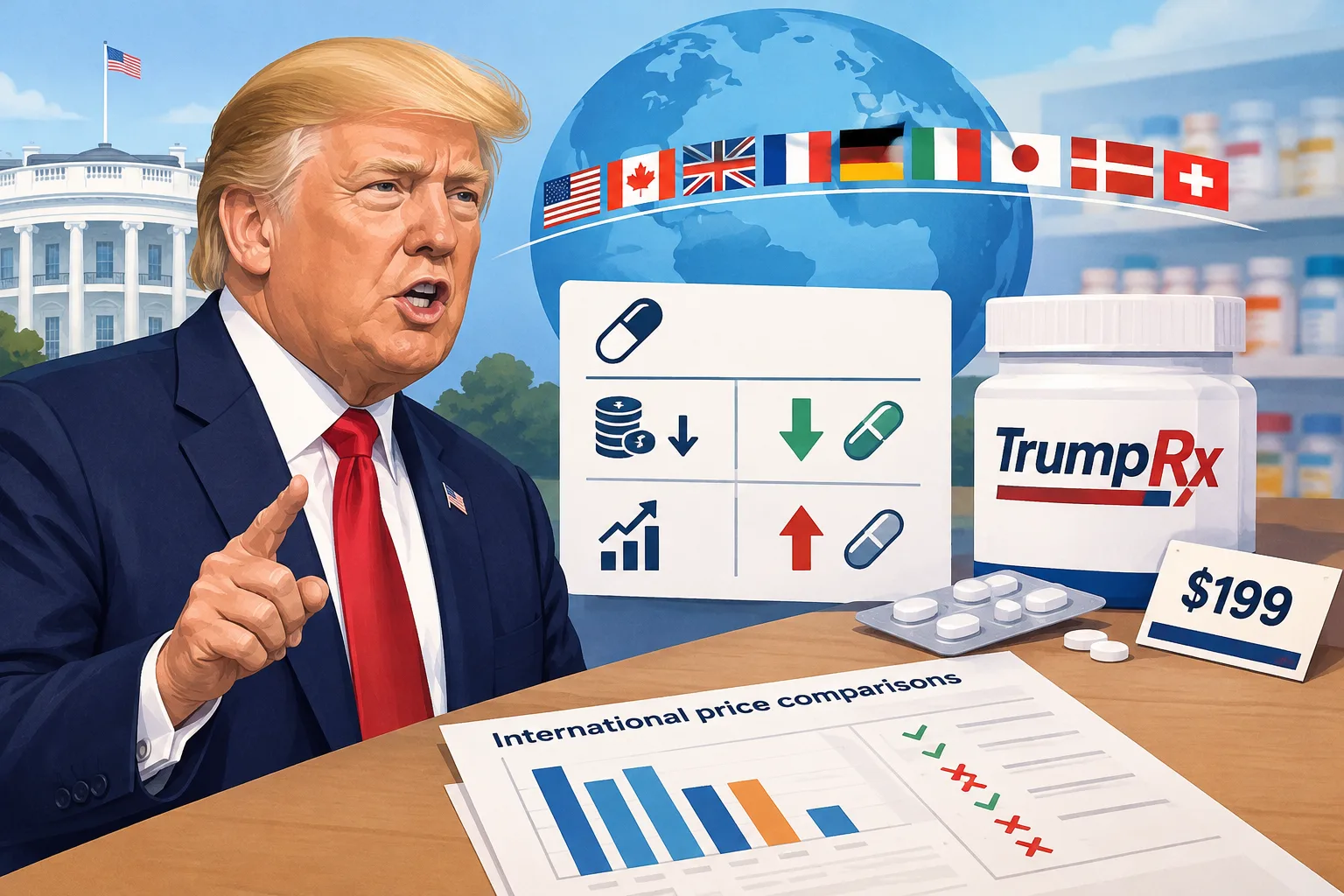
President Donald Trump’s claim that the United States now pays the world’s lowest drug prices is misleading. His agreements include specific discounts and future pricing commitments, but his administration’s own rules and international comparisons do not establish the nationwide reversal he describes. [2] [4]
In a Truth Social post at 9.18pm EDT on 19 October 2026, Trump said his most-favoured-nation (MFN) agreements had taken Americans from paying the “HIGHEST Drug Prices anywhere in the World” to the “LOWEST Drug Prices”. The post, preserved by the Trump’s Truth archive, cited differences of 300–700% but identified no medicines or comparison prices. [1]
He had used nearly identical wording at a midterm rally in Kalispell, Montana, on 14 October, according to Factbase’s transcript. There he urged his audience: “Don't let anybody else take credit.” [11]
The White House Council of Economic Advisers (CEA) defines MFN in its May 2026 framework by reference to eight wealthy countries: the other G7 members plus Denmark and Switzerland. It uses prices after manufacturer rebates and discounts, adjusts them for GDP per head using purchasing-power parity, and selects the second-lowest. Medicaid’s published model design uses the same benchmark — not an unadjusted worldwide minimum. [2] [3]
For medicines already on the market, the framework sets out rebates for state Medicaid health programmes and discounted offers to people buying outside insurance. Its wider commitment covering private insurance applies to future drug launches, measured by a manufacturer’s average US net price — not every individual patient’s bill. [2]
Eli Lilly’s 6 November 2025 announcement said its agreement contained no pricing obligations in the commercial channel. In return for its commitments, the company said it would receive three years of tariff relief and would not be subject to future pricing mandates.
12 listed sources · explore evidence, limitations and provenance.
Sign in to give this article a thumbs up or down.
Private test discussion. Comments are readers’ views and are not yet automatically fact-checked. Editing is available for 60 seconds after posting.
Ask your question with @newsmadeclear or @nmc. You may receive 5 starter credits once after checks on your confirmed email and browser. The offer is once per person; extra accounts do not entitle you to another bonus. There is no monthly refill. Previous balances remain. A question costs 1 credit, including additional research you permit. A source you provide that demonstrably improves the article earns 5 credits. If your question helps Astra find the missing source and improve the article, you receive 1 credit back.
Sign in with a confirmed reader account and choose a username to read comments and participate.
Sorting applies to top-level comments; replies remain oldest first. New comments and likes can change the order. Refresh for the current ranking.
Loading comments…
Interested in advertising with News Made Clear? Explore our pilot.
The CEA describes the policy’s goal as narrowing the international gap through both US price cuts and higher prices in other wealthy countries. A smaller gap therefore need not result from American price reductions alone. [2]
On 18 September, the White House said it had agreements with 26 manufacturers covering 89% of the branded drug market. That figure describes the companies’ market presence, not the proportion of prescriptions already purchased at MFN rates. The administration also reported more than $700 million in savings through TrumpRx since its February launch and forecast about $600 billion in savings over ten years. [9]
The historical US price problem was real. RAND’s comparison using 2022 data found gross US prices for original brand-name medicines were 4.22 times prices in peer countries. Even after an estimated adjustment for US manufacturer rebates, they remained more than three times as high. Unbranded generics were already cheaper than in most peers, but original branded medicines accounted for 87% of US drug spending at gross manufacturer prices. [5]
A Peterson-KFF Health System Tracker analysis published on 24 September 2026 compared 32 TrumpRx brand-name products without US generic or biosimilar competition. It used prices listed on TrumpRx on 25 August and foreign public prices from up to 11 wealthy countries. Five products were cheapest in their respective comparisons; 13 were the most expensive. Still, 17 were below the average of available peer-country prices and 15 above it. [4]
This was a selected August snapshot, not a national price index or a test of changes caused by the agreements. Foreign public prices do not always represent a patient’s bill, and the study made no purchasing-power adjustment. It also found German prices higher for 14 of 24 matched products. [4]
Trump’s percentages involve a separate distinction. The post calls them “Price Differences”, not percentage reductions. A price 700% higher than another is eight times as high; cutting it to the lower price would be an 87.5% reduction. That arithmetic is possible, but the post gives no prices or basis of comparison from which to calculate his figures. [1]
Ozempic illustrates how specific a cash offer can be. On 20 October, TrumpRx advertised $199 for each of the first two monthly fills for eligible new self-paying patients using 0.25mg or 0.5mg doses. The introductory offer is available until 31 December 2026. Subsequent monthly prices are listed at $349 for 0.25mg, 0.5mg or 1mg, and $499 for 2mg. [6]
The page warns that insurance co-payments may be lower and that purchases under the offer do not count towards an insurance deductible or out-of-pocket limit. Specific offers can be valuable to eligible patients; they do not establish that Americans as a whole now pay the world’s lowest drug prices. [6] [2]