News Made Clear · Loading…

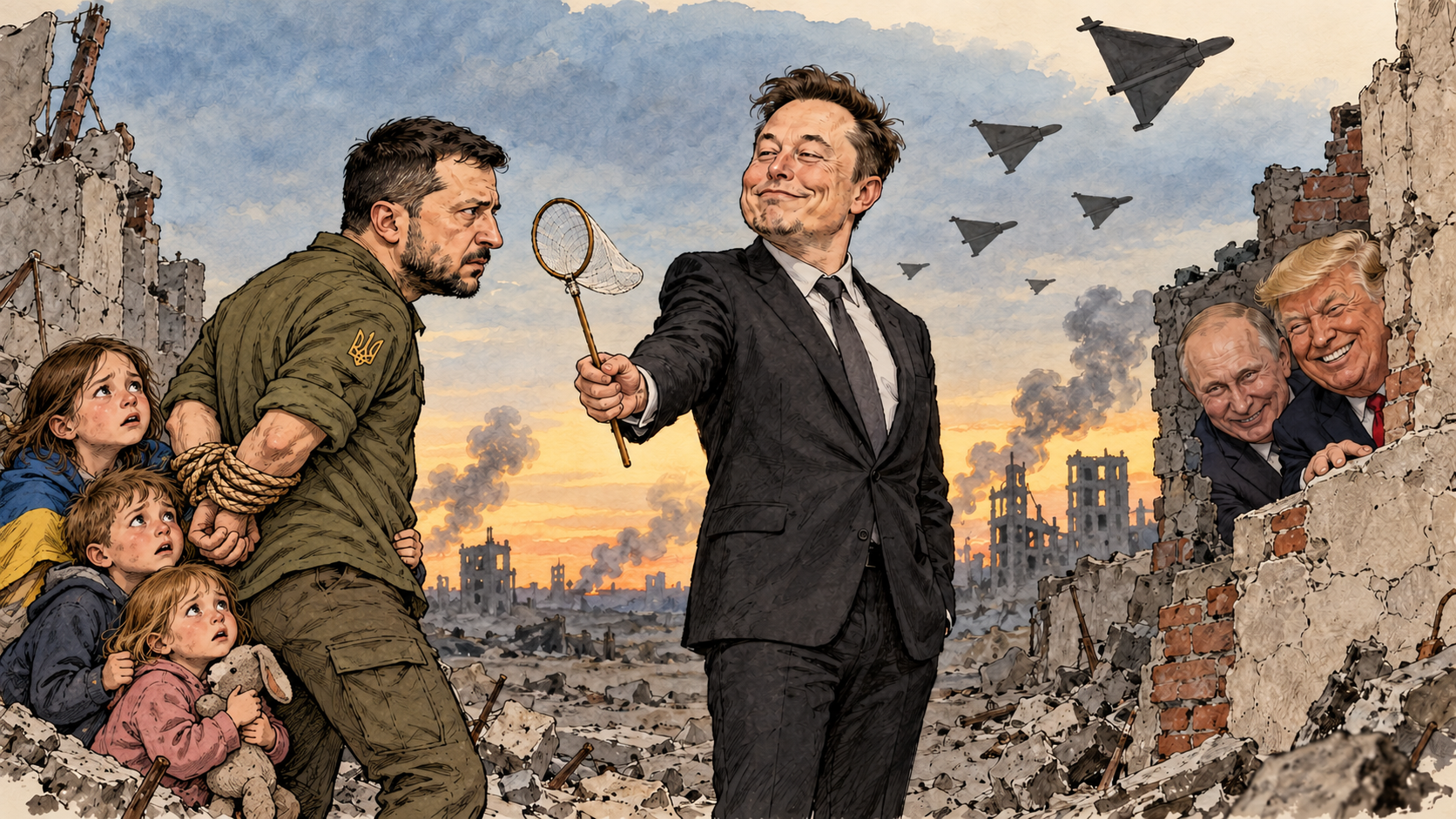
OPINION · The ‘smartest man in the world’ makes a car fly. A technical spectacle with a dark edge: that same week, a restriction imposed by his satellite company hampers Ukrainian drones tasked with intercepting Russian attack drones. Musk likes to show us the future he imagines for humanity. But what is that promise worth if his company obstructs the protection of people who first have to survive the next night?
Editorially supplied research. Sources and references accompany the article.
Review information is loading.
On 15 October, a Tesla Roadster prototype performed a barrel roll using thrusters at SpaceX’s test facility in McGregor, Texas. Musk had another spectacular image for his vision of the future. A day earlier, Ukrainian units had reported losing their satellite connections while their drones were in flight. According to Ukrainian officials, equipment used to bring down Russian drones was also affected.
Those defences protect people from the weapons Russia uses to attack their country. Weakening them is unacceptable. A satellite provider on which those defences depend bears responsibility for the consequences of restricting its service. Protecting civilians is not a favour a supplier can withdraw at will.
The US turned to Ukraine, according to Zelensky, for help protecting American troops from Iranian drones. He said Ukraine had sent experts to an American base in Jordan. Reuters also reported in March that Ukrainian teams were in the Emirates, Saudi Arabia, Qatar and Kuwait. Trump said Washington did not need the help.
Ukraine was sharing knowledge it had acquired under Russian attack. Its people were deployed to help protect lives elsewhere from the same type of weapon. On 10 March, Zelensky stressed that partners requesting Ukrainian help should continue supporting Ukraine’s air defences.
According to Reuters, American LUCAS attack drones used Starshield terminals in the Iran war. Those terminals can connect both to the Starlink network and to a separate Starshield constellation. On 26 May, the news agency reported that SpaceX had demanded a more expensive aviation subscription and that the Pentagon had agreed. Musk called the report inaccurate and said the drone manufacturer had improperly used the civilian Starlink system. The Pentagon also disputed the reporting.
What rule or consideration allows such American attack missions under certain conditions while Ukrainian interception equipment faces restrictions? Whether US missions ever faced comparable restrictions has not been established. ‘Military use’ alone is not an adequate explanation: stopping a Russian attack is military use too.
Half a year later, Ukrainian interceptor drones face restrictions imposed by an American company. The US asks for Ukrainian know-how to protect Americans, yet Ukrainians are obstructed when they try to protect themselves. Weaker Ukrainian defences benefit Russia. For Ukrainian civilians, they mean greater danger. It is a shameful way to repay a partner’s help.
According to The Wall Street Journal, Musk personally ordered the restriction. CBS also attributes the decision to him, following discussions with US government officials. That goes beyond the proposal to Trump we described in
27 listed sources · explore evidence, limitations and provenance.
Sign in to give this article a thumbs up or down.
Private test discussion. Comments are readers’ views and are not yet automatically fact-checked. Editing is available for 60 seconds after posting.
Ask your question with @newsmadeclear or @nmc. You may receive 5 starter credits once after checks on your confirmed email and browser. The offer is once per person; extra accounts do not entitle you to another bonus. There is no monthly refill. Previous balances remain. A question costs 1 credit, including additional research you permit. A source you provide that demonstrably improves the article earns 5 credits. If your question helps Astra find the missing source and improve the article, you receive 1 credit back.
Sign in with a confirmed reader account and choose a username to read comments and participate.
Sorting applies to top-level comments; replies remain oldest first. New comments and likes can change the order. Refresh for the current ranking.
Loading comments…
Interested in advertising with News Made Clear? Explore our pilot.
Musk says the US government determines the restrictions. Trump denied giving the order himself and said he did not think Musk was behind it either. Reuters had earlier reported that the instruction came from the White House, without naming an individual decision-maker. The precise division of responsibility remains disputed. None of those accounts makes obstructing interception equipment acceptable.
The limit of roughly 160 kilometres per hour concerns the movement of the satellite terminal. Above that speed, the connection can drop while a drone keeps flying. One Ukrainian unit told Reuters it was experiencing interruptions of ten to twenty seconds at just 110 to 120 kilometres per hour. Missions were cancelled.
Adviser Serhii Beskrestnov warned of problems intercepting Russian jet-powered drones. He said an information channel used by combat helicopters fighting Shaheds had also been affected. The military nature of that equipment does not make the civilians it protects any less important.
The first reports of service being restored came on 15 October. Commander Yevhen Karas’s unit was able to resume operations. Yet on 19 October, Zelensky was still reporting restrictions affecting, among other things, defence against Shaheds. The official account of his 20 October conversation with Marco Rubio again said Starlink and Starshield needed to be restored. Invoking terms of use, as Defence Secretary Pete Hegseth did, offers no protection against an incoming drone.
Meanwhile, Musk had publicly turned against Zelensky. On 10 October, he responded to a White House video in which Trump told Ukraine to leave Russian refineries and diesel fuel alone: “Zelensky has gone too far.” That post was about diesel. Trump had been pressuring Ukraine over refinery attacks since September.
Three days later, on the evening of 13 October, Ukrainian units began experiencing the connection problems, according to CBS. The president of the country under attack was publicly rebuked; his defenders then faced a satellite restriction. Anyone so concerned about Russian economic damage should give at least as much weight to protecting Ukrainian lives.
Russia, meanwhile, had economic prospects to look forward to. On 16 October, Putin’s investment envoy Kirill Dmitriev said Russia and the US were discussing joint data centres, including projects using small nuclear power plants. A nuclear-powered data centre had already been reported as part of a broader Russian-American business package in February. Dmitriev named no American customer, location or signed contract.
On 8, 9 and 11 October, Ukraine struck Yandex data centres that support ordinary services. Yandex services have also been used for Russian influence operations. A Lund study published in May 2025 describes how the Social Design Agency stored memes and screenshots on Yandex Cloud. Evidence of published bot comments was stored there too: a record of propaganda work delivered.
In September, Graphika documented a Russia-linked campaign targeting Democratic candidates in the 2026 US midterms. Fabricated news footage and manipulated celebrity videos sought to portray Democrats as criminals. No link between that campaign and the Yandex facilities that were hit has been established.
Musk has also helped spread a fabrication himself. AFP documented how, in February 2025, he shared a video bearing the E! News logo and falsely claiming that USAID had paid for Hollywood stars’ trips to Ukraine. The video was fake; ISD attributes it to Operation Overload. Musk thereby gave anti-Ukrainian disinformation a much larger platform.
In our earlier analysis of satellite power, Russian diesel and Ukraine’s security, we described the dangers of that dependence. Russia can hold out the prospect of economic cooperation. Musk can publicly condemn Zelensky and, according to the new reporting, order restrictions on the satellite service. Ukrainian civilians cannot simply turn to another power broker for protection.
Russia remains responsible for its attacks. SpaceX and Washington bear responsibility for their own interventions in the defences against them. Weakening those defences becomes no more reasonable when dressed up in contractual language. Protecting human lives should not be a bargaining chip for a businessman or a foreign government.
A flying car can wait. A drone that has to intercept a Russian Shahed cannot. Anyone who restricts that defender’s connection makes other people’s safety subordinate to their own terms. No futuristic show can make up for that.