News Made Clear · Loading…
Category
Regions
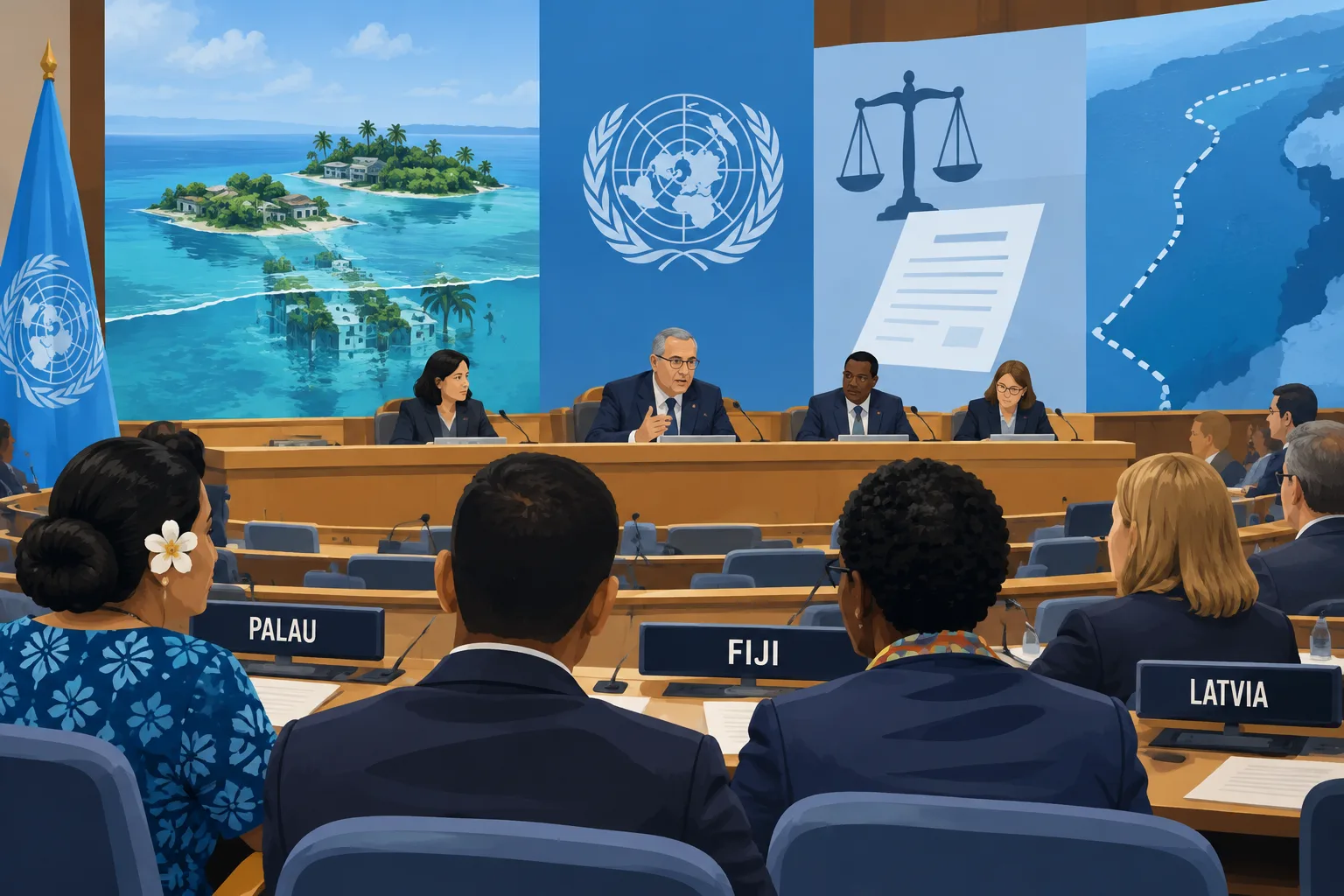
UN legal committee opens two-week review of international law work
Loading statistics…
The UN General Assembly’s Sixth Committee has begun a two-week review of the International Law Commission’s work, with delegates debating legal protections for people affected by sea-level rise and the prospects for treaty rules on officials’ immunity.
Review information is loading.
The UN General Assembly’s Sixth Committee has begun two weeks of debate on the International Law Commission’s work, including how international law should address rising sea levels and whether draft rules on immunity for state officials could underpin treaty negotiations.
The committee, which deals with legal matters, opened its review of the Commission’s annual report on 26 October. The work is divided into three clusters of topics. The first includes state officials’ immunity from foreign criminal jurisdiction, general principles of law and sea-level rise in relation to international law.
The sea-level discussion focused on the consequences for people and statehood as coastlines change. Speaking for the Alliance of Small Island States, Palau’s representative said that protecting a state and its maritime zones would be incomplete if the people affected were left unprotected. He pointed to possible measures including climate mobility arrangements, humanitarian pathways and steps to prevent statelessness.
Fiji, speaking for Pacific small island developing states, welcomed the Commission report’s conclusion that the UN Convention on the Law of the Sea contains no provision requiring states to update maritime boundaries once baselines and limits have been properly established. Fiji’s representative said maritime-zone stability and continuity of statehood were central to Pacific sovereignty.
Latvia, speaking for Estonia and Lithuania, supported the presumption that states can retain their legal identity even if their territory is partly or wholly submerged. Iceland, speaking for the Nordic countries, said those most affected could not bear the burden alone and called for mitigation to be treated as a core risk-prevention measure alongside adaptation.
Delegates also differed over the Commission’s draft articles on immunity for state officials. The representative of Iceland, also speaking for Denmark, Finland, Norway and Sweden, described the text as broadly acceptable and said it could serve as a basis for treaty negotiations.
The UK backed treaty negotiations as a longer-term option but said it would be premature to begin them immediately, citing divergent views on functional immunity, which concerns official acts. South Africa supported excluding immunity for certain serious crimes, including genocide, crimes against humanity, war crimes, aggression, slavery and the slave trade.
The Commission’s chair, Andreas Mavroyiannis of Cyprus, said the body had adopted 17 draft articles on officials’ immunity, 13 draft conclusions on subsidiary means for determining rules of international law and 12 draft guidelines on disputes between international organisations and private parties. The Sixth Committee’s review will continue over the next two weeks, covering further questions including disputes involving international organisations and non-legally binding agreements.
How do we know?
1 listed sources · explore evidence, limitations and provenance.
Sign in to give this article a thumbs up or down.
About this discussion and AI questions
Private test discussion. Comments are readers’ views and are not yet automatically fact-checked. Editing is available for 60 seconds after posting.
Sign in with a confirmed reader account and choose a username to read comments and participate.
Sorting applies to top-level comments; replies remain oldest first. New comments and likes can change the order. Refresh for the current ranking.
Loading comments…