News Made Clear · Loading…
Category
Regions
Continents
Dossiers
US data centre opposition reaches midterm ballots
Loading statistics…
Resistance to new AI data centres is becoming an election issue in the US. Local ballot measures, a national poll and energy-demand estimates show the stakes — and the limits of broad claims about costs and benefits.
Review information is loading.
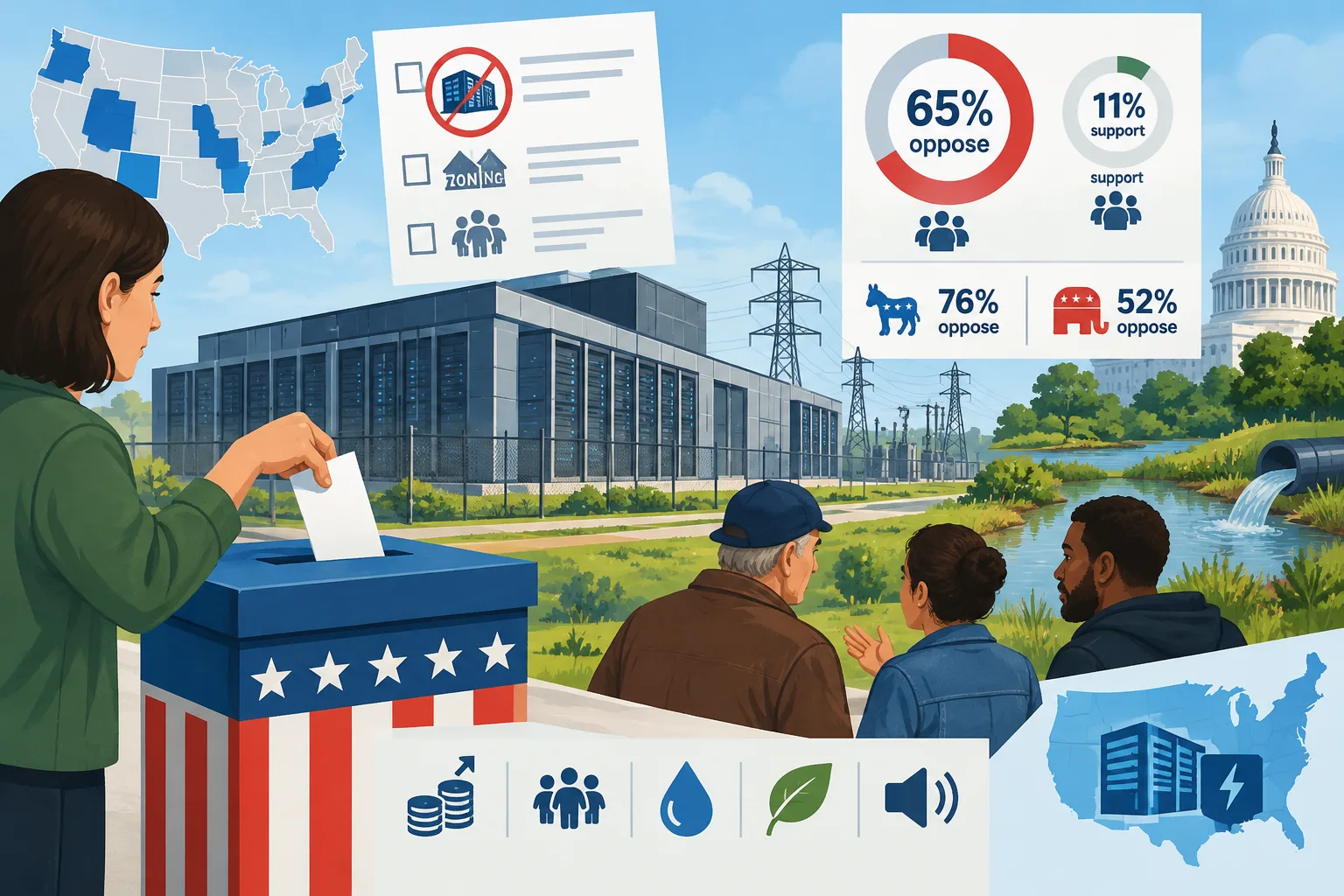
Voters in eight US states are due to consider 39 local measures concerning data centres at the 3 November midterm elections, according to Stateline. Some would ban facilities; others would change zoning rules or require voter approval. Opposition has also become an issue in state and federal campaigns, though the local ballot measures do not predict who will win those races.
A University of Massachusetts Amherst poll helps explain the pressure on candidates. Of 1,000 people surveyed in August, 65% opposed building an AI data centre in their own community and 11% supported it. Opposition crossed party lines: 76% of Democrats and 52% of Republicans were against a local project. The poll asked about AI facilities nearby, not all data centres or how respondents would vote. Its stated margin of error was 3.5 percentage points.
The scale of electricity demand gives the argument weight. Lawrence Berkeley National Laboratory estimates that US data centres used 192 terawatt-hours in 2024, or 4.7% of the country’s electricity. Its reference scenario puts the share at 11.8% by 2030, but that is a forecast, not consumption already recorded. National figures cannot show whether any particular project will raise local bills; that depends in part on how new supply and grid upgrades are paid for.
The legislative response is substantial, but the numbers need care. A National Conference of State Legislatures list updated on 15 September covers proposals in 16 states to halt or restrict data centre development. It includes measures marked failed or vetoed, alongside introduced bills and one that passed a legislature. It does not mean 16 bans are in force, or that all 16 proposals remain under consideration.
Supporters point to investment, tax revenue and jobs; opponents also raise concerns about water use, pollution, noise and land. In an analysis comparing counties with completed data centres against those with announced but cancelled projects, Brookings researchers estimated roughly 100–200 additional jobs in a typical county receiving its first large facility. They found stronger related telecommunications gains around large company-run sites than around facilities leasing space to other businesses. That estimate is not a jobs pledge for any new development.
Technology companies are responding with promises of more openness and local benefits, the Associated Press reports. They have also promised to meet power-infrastructure costs, an issue examined in our account of the administration’s data centre power pledge. For communities deciding on a project, the terms of those commitments matter more than a national jobs or electricity average.
How do we know?
8 listed sources · explore evidence, limitations and provenance.
Sign in to give this article a thumbs up or down.
About this discussion and AI questions
Private test discussion. Comments are readers’ views and are not yet automatically fact-checked. Editing is available for 60 seconds after posting.
Sign in with a confirmed reader account and choose a username to read comments and participate.
Sorting applies to top-level comments; replies remain oldest first. New comments and likes can change the order. Refresh for the current ranking.
Loading comments…