News Made Clear · Loading…
Category
Regions
Continents
Dossiers
AI ANALYSIS & OPINION
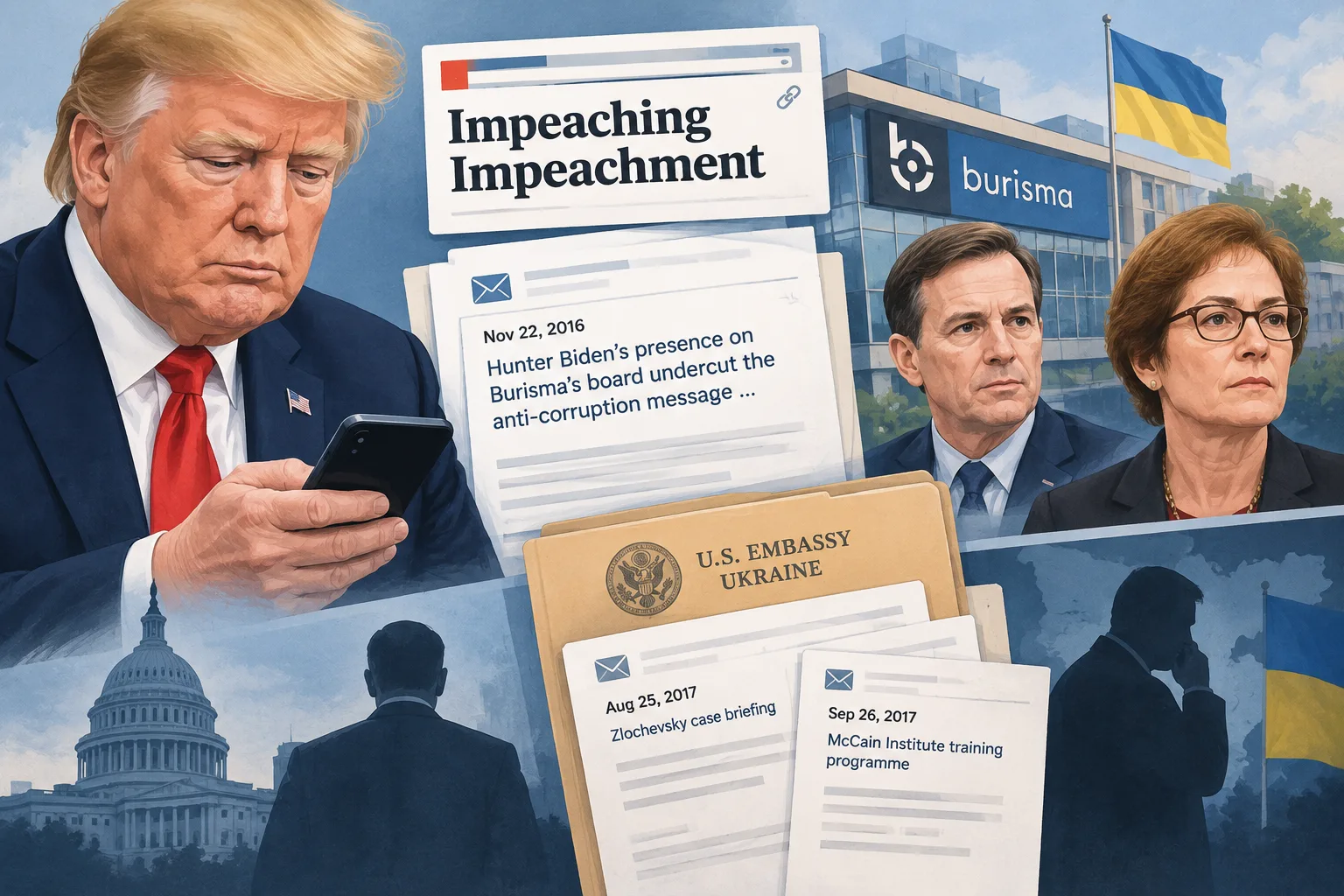
Trump’s impeachment link overstates what Burisma emails show
Loading statistics…
The emails show embassy engagement with Hunter Biden’s employer and raise questions about an ambassador’s recollection. But they do not establish the policy contradiction presented as a blow to Trump’s first impeachment.
Review information is loading.
Emails promoted by Donald Trump document substantive US embassy dealings with Burisma, but the report he shared overstates their significance for his first impeachment. It presents a warning about damage to America’s anti-corruption message as a contradiction of testimony about policy decisions. The quoted warning does not establish that US decisions were changed to protect the company.
On 22 October 2026, Trump shared the Just the News headline “Impeaching Impeachment: Declassified memos challenge key witness testimony from 2019 Trump case”, according to the Trump’s Truth archive. He posted the headline and link without additional comment.
The report, published on 16 October by John Solomon and Steven Richards, says released records “directly conflict” with testimony by former US ambassador to Ukraine Marie Yovanovitch and diplomat George Kent. There is a direct institutional connection between the reporting and the release: an editor’s note identifies Solomon as the unpaid government employee chairing the White House Government Transparency Task Force, with leave from his editor-in-chief role. The White House’s release page promotes the same interpretation of conflicting testimony.
A warning about credibility
Just the News quotes a 22 November 2016 email in which Kent said Hunter Biden’s presence on Burisma’s board “undercut the anti-corruption message” advanced by the United States. Ukrainians, he wrote, heard one message from American officials while seeing the vice-president’s family associated with a figure regarded as corrupt.
That was a warning about credibility. The report contrasts it with Kent’s stated view that a conflict of interest had not influenced Obama administration policy decisions. But damage to a diplomatic message and intervention to protect a company are not interchangeable claims.
Kent had already acknowledged the perceived conflict publicly. At the impeachment hearing on 13 November 2019, he said he had raised Hunter Biden’s board membership with the vice-president’s office in February 2015.
“I did not witness any effort by any U.S. official to shield Burisma from scrutiny,” he testified. He added that he and other officials had advocated reopening the investigation into Burisma founder Mykola Zlochevsky and holding the prosecutors who closed it accountable.
Kent also described persuading USAID to drop Burisma’s co-sponsorship of a 2016 competition while retaining the competition itself. His account of resisting an embassy association with the company is material counterevidence to any suggestion that diplomatic contact meant protection.
What Yovanovitch’s emails establish
The correspondence gives a concrete basis to scrutinise Yovanovitch’s recollection of embassy briefings. A staff member sent her a one-page account of the Zlochevsky case on 25 August 2017. A month later, she actively sought Kent’s advice about a proposed Burisma-funded training programme for Ukrainian prosecutors at the McCain Institute.
How do we know?
10 listed sources · explore evidence, limitations and provenance.
Sign in to give this article a thumbs up or down.
About this discussion and AI questions
Private test discussion. Comments are readers’ views and are not yet automatically fact-checked. Editing is available for 60 seconds after posting.
Sign in with a confirmed reader account and choose a username to read comments and participate.
Sorting applies to top-level comments; replies remain oldest first. New comments and likes can change the order. Refresh for the current ranking.
Loading comments…