News Made Clear · Loading…
Category
Regions
Continents
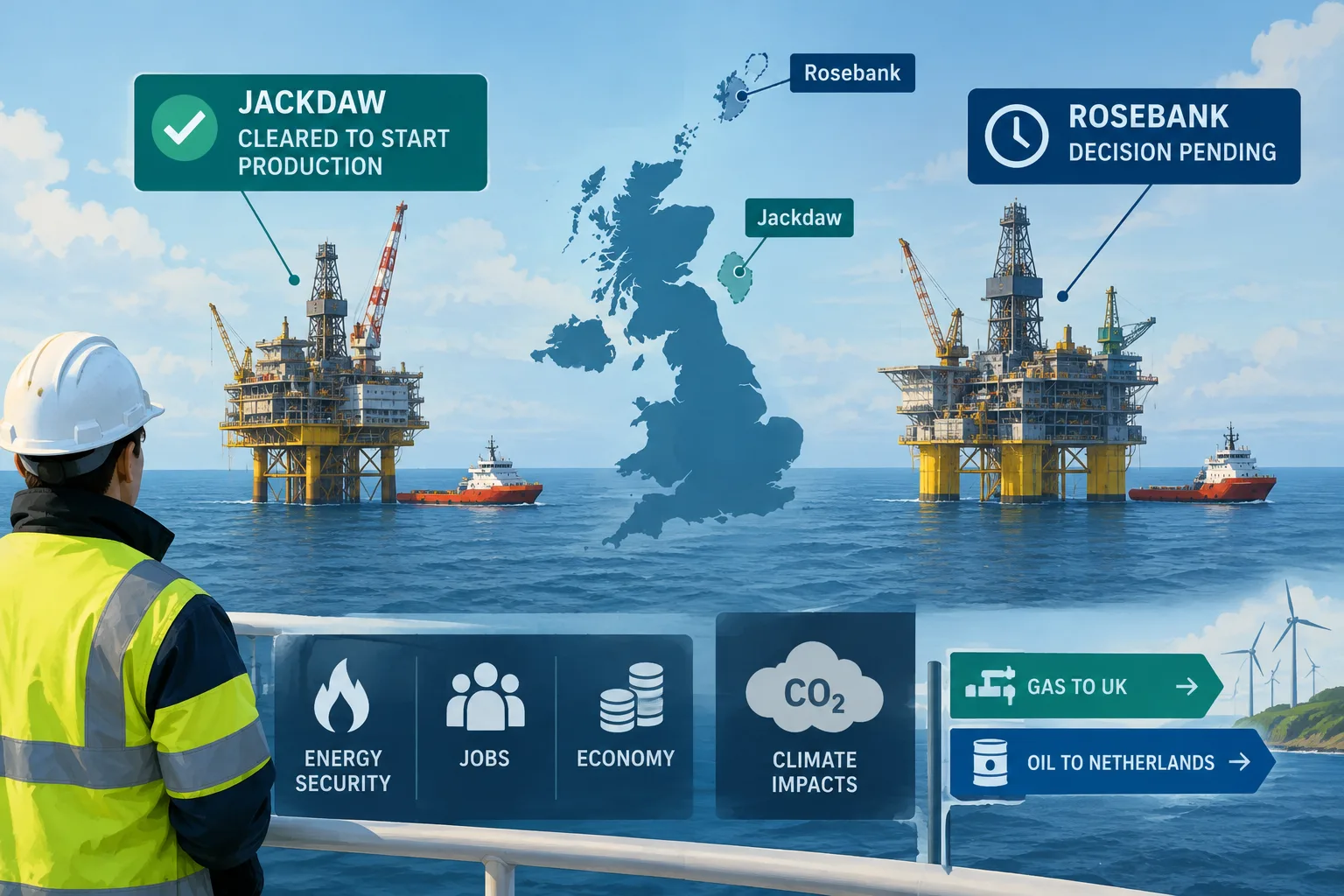
Jackdaw cleared to start production as Rosebank decision remains pending
Loading statistics…
Jackdaw has been cleared to begin production, but the UK has yet to make a fresh decision on Rosebank. The projects have renewed debate over North Sea jobs and energy security against their climate costs.
Review information is loading.
Jackdaw, a North Sea gas field, has been cleared to start production, while a fresh decision on the Rosebank oil field is still pending. The two projects have become a test of the UK government’s approach to existing oil and gas licences, with arguments over energy security, jobs and climate impacts. [1]
Jackdaw lies about 150 miles east of Aberdeen. The government says it could start supplying gas from the end of October and increase UK domestic gas production by about 6% at its peak. It estimates the field would support hundreds of jobs and add £2.9bn to the economy over its 11-year lifespan. [1]
Rosebank, north-west of Shetland, is the UK’s largest untapped oil field and would also produce some gas. If approved, it is expected to yield up to 500 million barrels over 25 years and could be operating by 2027. The BBC reports that the decision remains with the regulator and has not yet been passed to the energy secretary. [1]
Both fields were approved by the previous Conservative government, but in January 2025 the Court of Session ruled the consents unlawful because the climate impact of burning the extracted fuels had not been considered. The court required updated climate assessments and fresh ministerial decisions. Consultations on the revised proposals closed in August 2026. [1]
The dispute turns partly on what the projects would mean for energy costs and security. Jackdaw’s gas could be connected to the UK system, but Rosebank’s oil would mostly be sent to the Netherlands because UK refineries cannot process its heavier crude. More domestic production would not necessarily lower bills: prices are set in international markets, and the UK would remain reliant on imports, the BBC notes. [1]
The climate estimates are also contested. Adura, the joint venture operating both fields, estimates Jackdaw could produce 23.6 million tonnes of carbon over its lifetime, while an alternative figure cited in the article is 35.8 million tonnes. Rosebank’s projected emissions are almost 250 million tonnes. Adura argues that replacing some imported US liquefied natural gas with Jackdaw gas would avoid emissions; campaigners counter that the displaced gas would still be burned elsewhere.
How do we know?
1 listed sources · explore evidence, limitations and provenance.
Sign in to give this article a thumbs up or down.
About this discussion and AI questions
Private test discussion. Comments are readers’ views and are not yet automatically fact-checked. Editing is available for 60 seconds after posting.
Sign in with a confirmed reader account and choose a username to read comments and participate.
Sorting applies to top-level comments; replies remain oldest first. New comments and likes can change the order. Refresh for the current ranking.
Loading comments…