News Made Clear · Loading…
Category
Regions
Continents
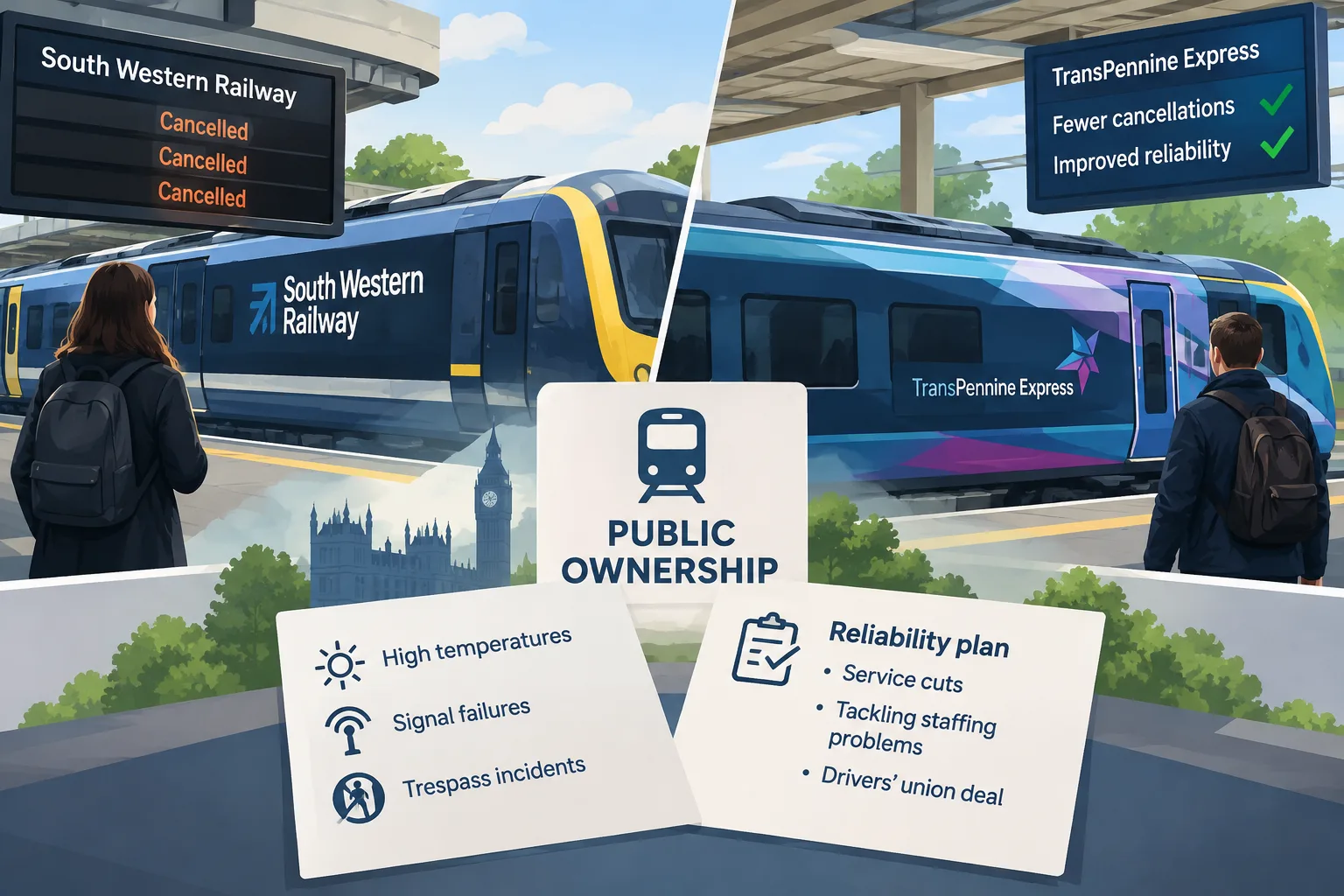
SWR cancellations rise in first year of public ownership, BBC News reports
Loading statistics…
Cancellations rose at South Western Railway after its transfer to public ownership, while another state-run operator improved, BBC News reports. Neither trend settles whether ownership is making trains more reliable.
South Western Railway (SWR) saw cancellations rise during its first year in public ownership, BBC News reports — a reminder that changing who runs a train service does not necessarily bring an immediate improvement for passengers. According to the BBC, SWR transferred in May 2025 and was the first of six passenger operators brought into public ownership under Labour by October 2026. BBC News reports the government’s argument that high summer temperatures, signal failures and trespass incidents affected SWR’s early performance. [1]
The picture differs elsewhere. BBC News reports that TransPennine Express was taken into public ownership under the previous Conservative government in 2023 and has seen cancellations fall after a reliability plan that included cutting some services and tackling staffing problems. The report says a new deal with the drivers’ union also helped, but that TransPennine Express’s cancellation rate remained above the Great Britain average in the year to August 2026. [1]
The government argues that official figures suggest publicly owned operators perform better overall on punctuality and cancellations than operators still run under Department for Transport contracts with private companies. The cancellation trends reported by BBC News for SWR and TransPennine Express, alongside the government’s comparison cited in the same report, do not on their own establish what effect public ownership has had on reliability. BBC News identifies infrastructure, previous performance and exposure to disruption as complicating factors, and reports that only SWR and c2c among Labour’s transfers have completed a full year in public hands. Former Office of Rail and Road chair Stephen Glaister told the BBC he thought a decade was needed to assess the impact of nationalisation. [1]
According to BBC News, the changes concern passenger operators, not ownership of the entire railway; Network Rail was already publicly controlled, while private rolling-stock companies still own the trains. In its October 2026 report, BBC News says that the government plans to bring the running of trains and tracks together under Great British Railways, but that the body had not yet been created and legislation to establish it was still going through Parliament. [1]
How do we know?
1 listed sources · explore evidence, limitations and provenance.
Sign in to give this article a thumbs up or down.
About this discussion and AI questions
Private test discussion. Comments are readers’ views and are not yet automatically fact-checked. Editing is available for 60 seconds after posting.
Sign in with a confirmed reader account and choose a username to read comments and participate.
Sorting applies to top-level comments; replies remain oldest first. New comments and likes can change the order. Refresh for the current ranking.
Loading comments…