BepiColombo reaches Mercury orbit after early thruster cutoff, complicating December manoeuvre
BepiColombo made it into orbit around Mercury after a thruster burn ended early, but the spacecraft is now on a different path and its December separation manoeuvre will be more complicated.
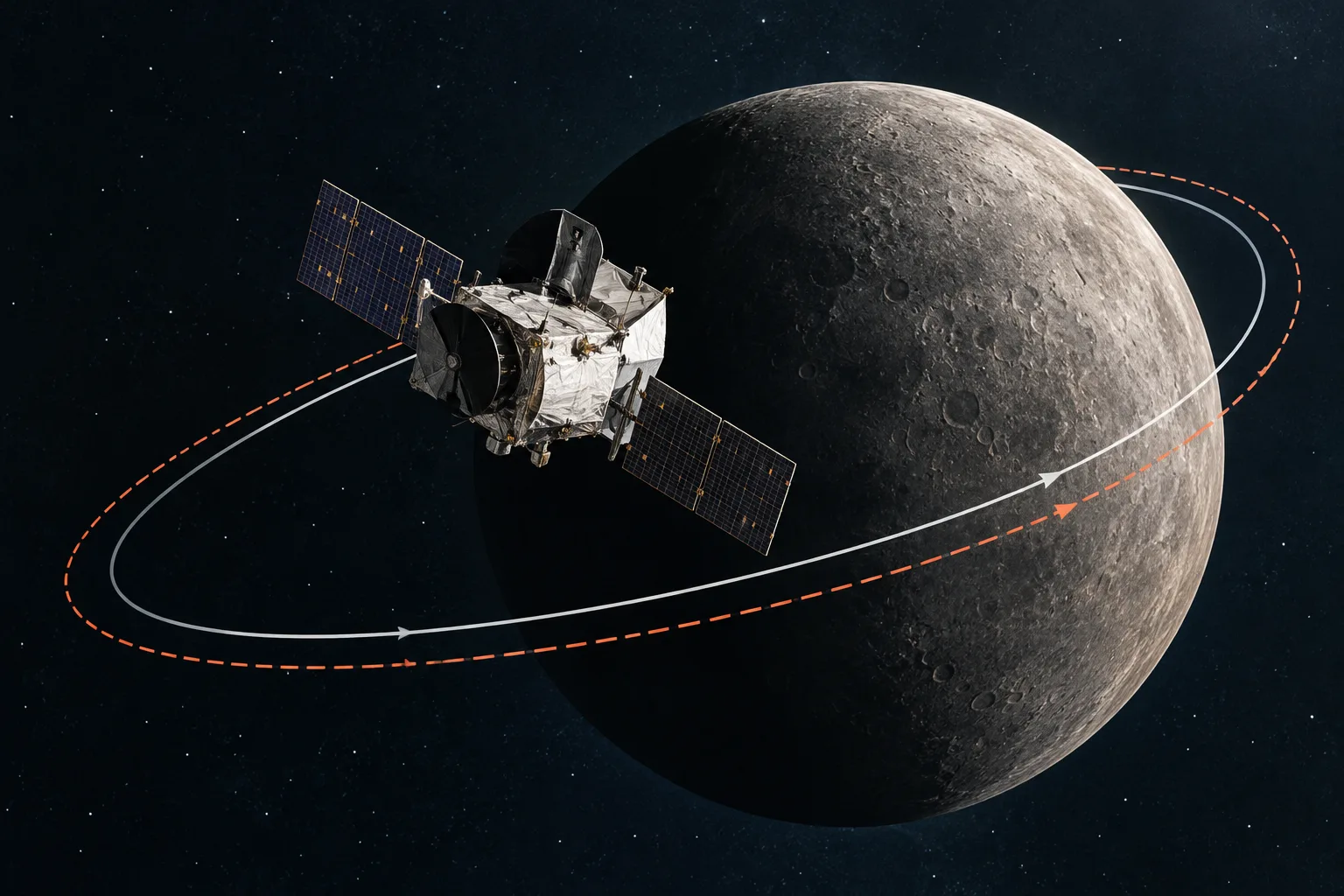
BepiColombo has reached orbit around Mercury, but a thruster burn that ended nine minutes early left the spacecraft in a different orbit from the one planned. Engineers now face a more complicated separation manoeuvre in December, with less time for some of the adjustments needed beforehand.
The joint European Space Agency and Japan Aerospace Exploration Agency mission entered Mercury orbit on 21 November after an eight-year journey. Its thrusters were meant to fire for 37 minutes; the burn stopped after 28. The spacecraft nevertheless achieved orbit, though it now circles the planet every 75 hours rather than the planned 58.
The unexpected interruption put the probe into safe mode. Mission operations chief Ignacio Tanco said engineers initially had to establish whether it had slowed enough to be captured by Mercury’s gravity or had flown past. The team confirmed it was in orbit after analysing data for four hours.
The cause was a timing mismatch between guidance software and the thruster controls, according to Tanco. It triggered an unusually strong command that interrupted the burn. The ESA later calculated a one-in-six chance of this glitch occurring; the scenario had been considered, but not used in training runs before the orbit insertion attempt.
The spacecraft’s two science orbiters are due to separate on 9 December. The new orbit changes the timing of planned trajectory adjustments, and some will need to last longer. Tanco said the mission had “less margin” for further problems, though the spacecraft was operating as expected.
BepiColombo’s arrival has already been delayed by 11 months after a propulsion problem in 2024 forced a change of route. The scientific phase is currently planned to begin in April 2027. Once the orbiters separate, engineers will also have to operate a newly configured spacecraft; Tanco said there were “significant question marks” over how it would behave.
The mission carries two orbiters with different instruments and is intended to study both hemispheres of Mercury. Its findings could help address questions about the planet’s size, dense composition and magnetic field. Only one previous spacecraft, NASA’s MESSENGER, has entered Mercury orbit.
Sign in to give this article a thumbs up or down.
From the discussion
Private test discussion. Comments are readers’ views and are not yet automatically fact-checked. Editing is available for 60 seconds after posting.
Sign in with a confirmed reader account and choose a username to read comments and participate.
Sorting applies to top-level comments; replies remain oldest first. New comments and likes can change the order. Refresh for the current ranking.
Loading comments…