POLITICO names six Republican senators who could negotiate with Democrats in 2027
With Democrats expected to hold 56 Senate seats, POLITICO names six Republicans who could be potential partners on legislation in the next Congress.
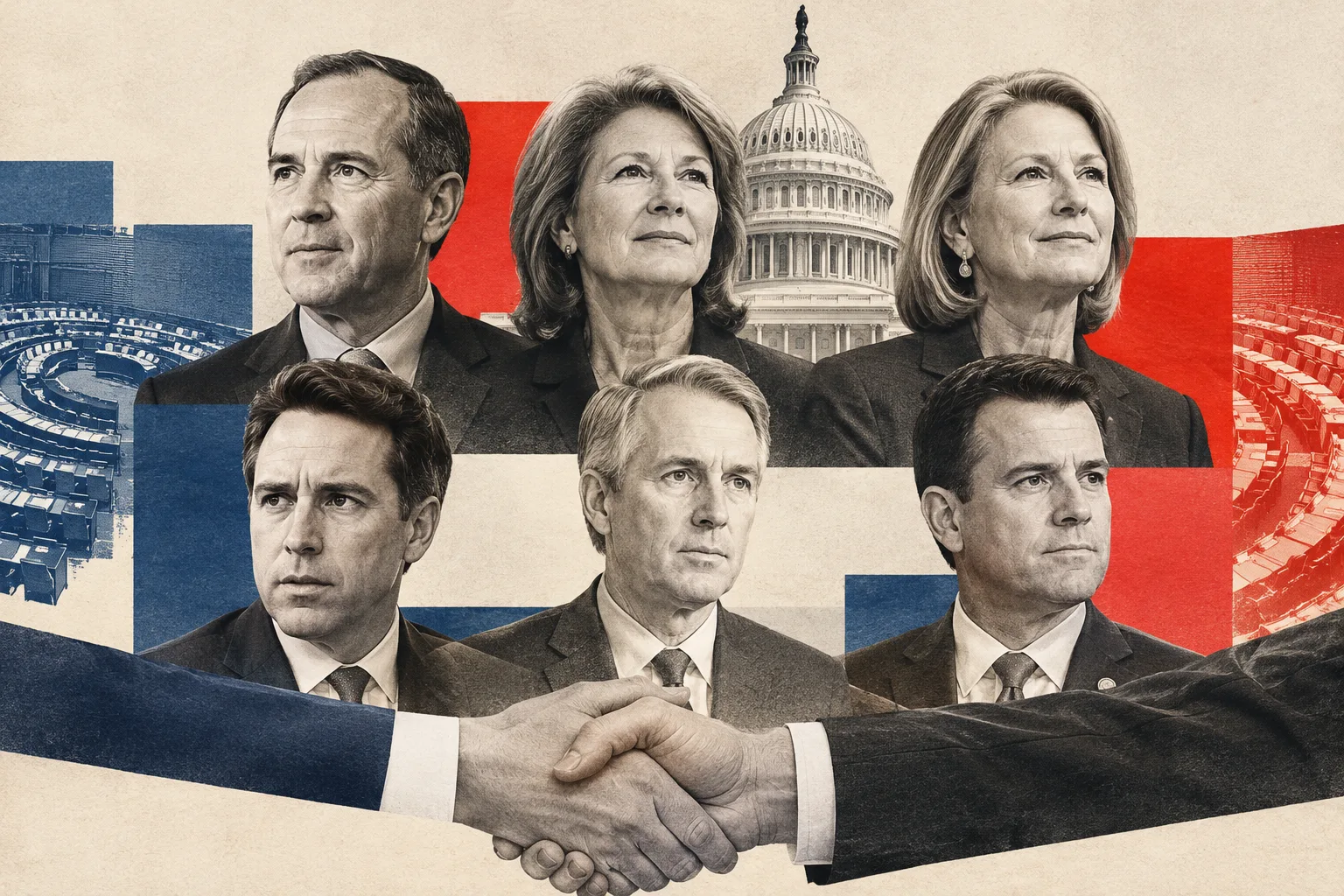
Democrats will need Republican support to pass most legislation in the next US Congress, and POLITICO has identified six GOP senators it expects to be among their potential negotiating partners: John Curtis, Lisa Murkowski, Shelley Moore Capito, Josh Hawley, James Lankford and Todd Young.
The calculation is shaped by Senate rules. Most bills need 60 votes to advance, while Democrats are expected to hold 56 seats. Some progressives want to abolish the filibuster and pass legislation with a simple majority, but many Democratic senators are wary of doing so. Party leaders are instead looking for measures that could attract Republican votes.
The six senators are not a unified bloc, and their scope for breaking with their party varies. POLITICO points to possible common ground on artificial intelligence, energy, health care, infrastructure and government funding, while noting political constraints on several of them.
Curtis, a Utah Republican who has criticised some positions taken by Donald Trump, said he was looking for proposals that overlap with his priorities and principles. He identified AI, public lands and forest management as areas for possible cooperation.
Murkowski of Alaska has a record of bipartisan dealmaking and could gain influence if she secures the top Republican post on the Senate Appropriations Committee. She faces a challenge from Kansas senator Jerry Moran for that position. West Virginia senator Capito, who chairs the Environment and Public Works Committee, helped negotiate a bipartisan permitting bill that passed the Senate the previous week.
Hawley, a Missouri Republican, has worked with Democrats on proposals concerning data-centre power and health-care monopolies, and has expressed interest in raising the minimum wage. Lankford of Oklahoma previously negotiated an immigration agreement with Democrats that did not take effect after Trump opposed it. POLITICO notes that Lankford rarely breaks with his party and faces re-election in 2028 in a strongly Republican state.
Young of Indiana has worked with Democrats on AI legislation and was a key architect of the bipartisan 2022 CHIPS and Science Act. But he, too, faces re-election in 2028, and POLITICO reports that a conspicuous break with Trump could expose him to a primary challenge.
The list is a forecast of where negotiations might begin, not a guarantee of votes. Whether any deals emerge will depend on the bills Democrats put forward and the political costs each Republican is willing to bear.
Sign in to give this article a thumbs up or down.
From the discussion
Private test discussion. Comments are readers’ views and are not yet automatically fact-checked. Editing is available for 60 seconds after posting.
Sign in with a confirmed reader account and choose a username to read comments and participate.
Sorting applies to top-level comments; replies remain oldest first. New comments and likes can change the order. Refresh for the current ranking.
Loading comments…