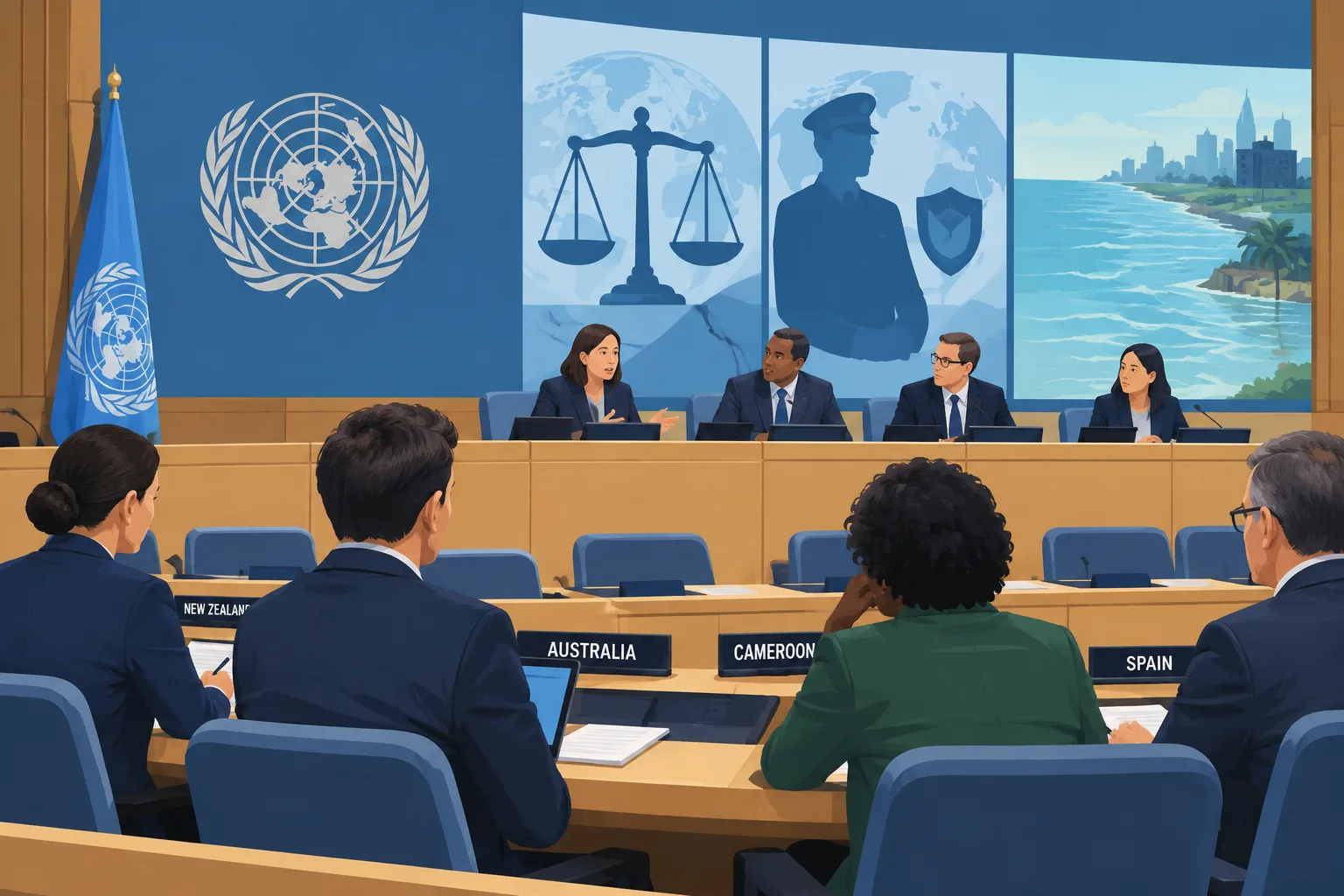
UN legal committee debates law principles, immunity and rising seas
Delegates at the UN General Assembly’s legal committee debated how to identify general principles of international law, safeguards around state officials’ immunity and the legal implications of rising sea levels.
Review information is loading.
The UN General Assembly’s Sixth Committee has heard calls for clearer safeguards on state officials’ immunity and for legal principles to be identified through a representative, evidence-based process, as it continued debating the International Law Commission’s annual report on 27 October.
The discussion covered three issues: general principles of law, immunity from foreign criminal jurisdiction for state officials, and rising sea levels and international law. The committee’s review is part of a two-week examination of the Commission’s work, which began on 26 October. Read our report on the opening of the review.
On general principles of law, delegates discussed how to establish that a principle is recognised by the international community and distinguish it from customary international law. New Zealand supported a two-step method for principles drawn from national legal systems: first establish that a principle is common to the world’s principal legal systems, then determine whether it can be transferred to the international legal system.
Cameroon called for a robust and objective demonstration of recognition, based on a genuinely representative range of legal systems and their historical, institutional and regulatory differences. Spain said the principles were not agreements between states imposing obligations in their mutual relations, and that their existence and content depended on recognition by the international community.
On immunity, Australia said exceptions should apply to serious international crimes as a category, rather than being developed offence by offence. Its representative also called for stronger procedural safeguards against unsubstantiated or politically motivated prosecutions, and said the draft articles should distinguish more clearly between safeguards for functional immunity, covering official acts, and personal immunity.
Guatemala raised concerns about the Commission’s draft article on determining immunity, citing precedents within the Organization of American States involving the recognition, arrest and transfer of leaders, as well as prosecutions of people captured abroad. Its representative said the draft should provide robust guarantees against violations of officials’ due process.
The debate follows earlier disagreements among delegates over the proposed limits on immunity for officials accused of serious crimes. Our report on those divisions details support for exceptions and concerns about their legal basis and possible politicisation.
Jamaica urged coherence between the UN Convention on the Law of the Sea and other approaches to climate-related sea-level rise. Its representative said the Montevideo Convention was silent on continuity of statehood in this context, but argued that silence should not be treated as loss of statehood. He said continuity was important to avoiding loss of nationality or statelessness as seas rise.
Delegates also welcomed the International Law Commission’s inclusion of work on obligations owed to the international community as a whole, known as *erga omnes*, and on states’ right to regulate in international investment law. Slovakia cautioned that work on *erga omnes* obligations should not prescribe decisions for international courts, while Ecuador said both topics could contribute to the development and codification of international law.
The UN says its account of the meeting is for information media and is not an official record.
Sign in to give this article a thumbs up or down.
About this discussion and AI questions
Private test discussion. Comments are readers’ views and are not yet automatically fact-checked. Editing is available for 60 seconds after posting.
Sign in with a confirmed reader account and choose a username to read comments and participate.
Sorting applies to top-level comments; replies remain oldest first. New comments and likes can change the order. Refresh for the current ranking.
Loading comments…